
Anaerobic digestion

High biogas production
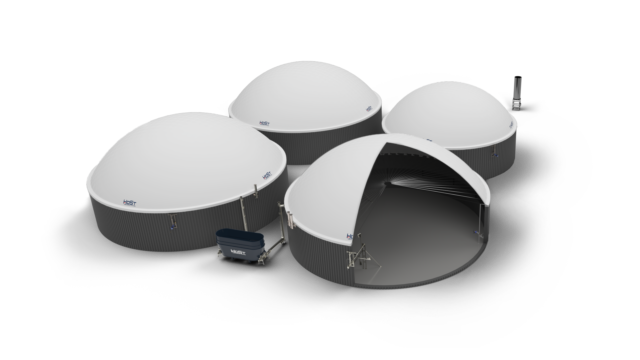
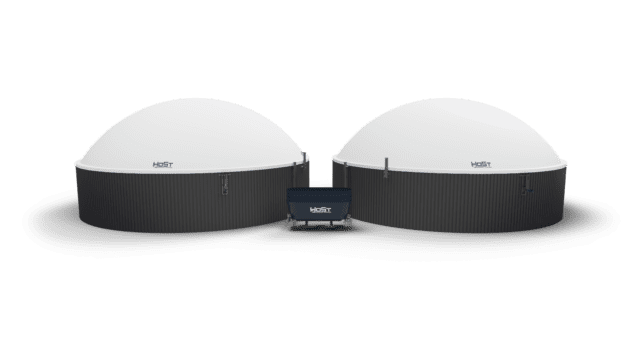
Anaerobic digesters from HoSt achieve high process stability, availability, and conversion. Due to our renewed mixer configuration, our anaerobic digesters are capable of running on a high dry matter content. Resulting in a higher output per m3 reactor volume and lower investment costs. Moreover, the risk of silt build-up, drifting layers and foam layers are maximally mitigated. The digesters have in-tank H2S removal, heat recovery, and patented double membrane roofs – further reducing operational costs. Additionally, Greenstep technology improves biogas production and mixability of the digester.
Anaerobic digestion is applied in the following turnkey solutions

Features
- Convert organic waste, organic residues, and manure to biogas
- Easy to operate due to in-house developed software
- Lowering of Carbon Intensity score (CI-score)
- Patented double insulated membrane roofs
- In-tank H2S removal
- Ability to run on high dry matter content in the digester
- Robust plants due to High-quality equipment

AD technology
To achieve maximal flexibilty, HoSt offers various Infeeder systems. Based on the type of feedstock the most suitable system will be selected for the project. The solid feeders are generally placed on weighing cells to ensure an accurate input of products. Additionally, HoSt offers different types of liquid storage tanks. The selection of the best option is based on customer preference, type of waste, and local climate. The tanks can be heated, insulated, and offered in many capacities. HoSt has constructed numerous AD plants worldwide with all types of feedstock and across various industries.

Frequently asked questions
What does anaerobic digestion produce?
Two outputs: biogas, a methane-rich renewable gas, and digestate, a nutrient-rich residue used as a biofertiliser. The biogas can be burned for heat and power or upgraded to biomethane, and with recovery the biogenic CO2 becomes a saleable product. So the process turns one organic input into energy, fertiliser and CO2. More information.
How does anaerobic digestion differ from composting?
Composting is aerobic: it needs oxygen and releases the carbon as CO2, leaving only compost. Anaerobic digestion works without oxygen, captures the carbon as biogas for energy, and still produces a nutrient-rich digestate. For an organic stream, digestion recovers energy that composting loses. More information.
What is the difference between mesophilic and thermophilic digestion?
The two refer to operating temperature. Mesophilic digestion runs around 40C and is stable and robust; thermophilic runs around 55C, digests faster and improves pathogen reduction, but is more sensitive to process upsets. HoSt plants operate mesophilically, with thermophilic conditions available in the after-digester where the feedstock calls for it. More information.
Which materials can be digested?
A wide range of organic material, from manure and food waste to crop residues, fats and oils, and sewage sludge. The determining factor is digestible organic content; inert or contaminated material lowers yield and quality. A feedstock assessment establishes what a given mix will deliver. More information.


